How did Arabic, Islamic, and Jewish logicians connect valid inference with warranted knowledge?
Track temporal qualifications and distinguish the form of a syllogism from the evidence and explanation supplied by its premises.
Greek logical writings circulate through Syriac and Arabic scholarship. Translators and commentators also develop terminology and interpretations.
Source: Arabic and Islamic Philosophy of Language and LogicLogical scholarship in the medieval Arabic-speaking world involved translation, interpretation, criticism, and the construction of new systems. Its history extends far beyond the preservation of Greek texts for later European readers.
The labels in this title overlap without being interchangeable. Arabic was a language of scholarship used by Muslim, Christian, and Jewish authors. Islamic intellectual settings included many languages and communities. Jewish logical writing circulated through Arabic, Hebrew, and later Latin contexts.
The appropriate unit of explanation is therefore a particular author, text, school, or documented route of transmission.
Translation as intellectual work
Greek philosophical and scientific texts entered Arabic through a substantial translation movement, particularly in the eighth through tenth centuries. Syriac scholarship supplied important intermediaries, although the routes were not always a simple single chain.
Ḥunayn ibn Isḥāq, Isḥāq ibn Ḥunayn, and other translators worked within networks of patrons, physicians, philosophers, and scholars. The Baghdad Aristotelian tradition included Christian thinkers such as Abū Bishr Mattā ibn Yūnus and Yaḥyā ibn ʿAdī.
Translation required choices about technical vocabulary and relationships between grammatical and logical form. A term for predication or demonstration had to work within a new scholarly language.
The resulting logical culture developed its own debates about the relation of logic to grammar, philosophy, theology, and other disciplines. The historical account of language and logic in Arabic and Islamic philosophy provides an entry into these questions.
A reported debate between Mattā and the grammarian Abū Saʿīd al-Sīrāfī makes the stakes clear. Could logic claim authority over meanings independently of the grammar through which they were expressed? The account is a literary report, not an impartial transcript establishing that one discipline defeated the other. It preserves a serious challenge to the transfer of logical rules across languages: which features belong to reasoning generally, and which belong to the language used to express it?
Al-Fārābī and the organization of logic
Al-Fārābī, who died in 950, developed an extensive account of logic and its place among the sciences.

Sources and credit for Al-Fārābī
Mr.Nostalgic. Via Wikimedia Commons. Image source · Public domain · Biographical dates
His project included the relationship between language and thought, the forms of syllogism, and the difference between kinds of argument. Demonstration, dialectic, rhetoric, and poetry could be studied within a broader logical organization associated with the expanded Aristotelian curriculum.
The contrast among these forms concerns their purposes and the status of their premises. An argument designed to persuade an audience is not assessed in exactly the same way as a demonstration intended to yield scientific knowledge.
This broad conception helps explain why historical logical texts include subjects that a contemporary mathematical-logic textbook might assign to epistemology or rhetoric.
Conception and assent
A durable distinction separates the acquisition of a conception from assent to a proposition.
Understanding what a triangle is differs from judging that every triangle has a certain property. Definitions contribute to conceptual understanding; arguments contribute to warranted assent.
The distinction organizes questions about how knowledge is acquired. A definition can fail to identify the intended object even if a subsequent argument is formally valid. An assertion can lack justification even when its terms are understood.
Later authors refined these categories in different ways. They should be treated as part of a historical theory of knowledge and reasoning, rather than forced into an exact equivalence with modern syntax and semantics.
Ibn Sīnā's independent logical project
Ibn Sīnā, known in Latin as Avicenna, lived from 980 to 1037. His logical writings, including the logical sections of The Healing, reorganized and extended the inherited subject.

Sources and credit for Ibn Sīnā (Avicenna)
National Library of Medicine. Via Wikimedia Commons. Image source · No restrictions · Biographical dates
His treatments of propositions, modality, temporal qualification, hypothetical reasoning, and demonstration became central to later scholarship.
The history is not adequately described as a commentary on Aristotle with a few additions. Avicennan logic supplied a framework that subsequent thinkers developed, criticized, and taught through an extensive post-Avicennan tradition.
The specialist account of Ibn Sīnā's logic distinguishes the projects within his works and explains why their interpretation requires attention to his own terminology.
Why temporal qualification matters
Consider the claim “Every writer is moving.”
Does it concern everyone who is writing at the present moment? Everyone who has ever been a writer? Does the movement hold while the person is writing, throughout the person's existence, or at some unspecified time?
A person's remaining human while ceasing to write makes the distinction important. Predication tied to a temporary description cannot automatically be extended to every time in that person's life.
As a modern explanatory reconstruction, compare
with
The first says that movement accompanies writing. The second says that anyone who ever writes is always moving. The first does not entail the second.
This example is not offered as a transcription of an Avicennan formula. It illustrates why his distinctions about the subject's description and the time or modality of predication affect syllogistic inference.
A valid restricted inference
Suppose we have two appropriately synchronized claims: every person who is writing is moving at that time, and every person moving at a time is undergoing a change at that time.
Then the conclusion that every writer is undergoing a change while writing follows by connecting the predicates at the same time.
If the second premise instead said that every moving person is at some time undergoing a change, the conclusion's temporal strength would differ.
The logical problem is therefore not merely which term appears in which premise. One must track the qualifications attached to the predication.
Historical modal syllogistics develop such distinctions in their own formal vocabulary. Modern reconstructions are useful when they expose the issue without pretending that the original authors used the same semantics.
Two ways to organize a syllogism
Another Avicennan distinction separates connective from repetitive syllogisms. Roughly, the premises of a connective syllogism share a term or propositional component through which the conclusion is assembled. In a repetitive syllogism, the conclusion or its contradictory already occurs as a component of a premise. This division crosscuts the division between categorical and hypothetical propositions; it is not simply another name for it. The historical taxonomy and its qualifications are explained in the account of Avicenna's syllogistic.
A modern illustration of the first kind is a chain of conditionals:
The conclusion joins the outer components through the repeated middle component. An illustration of the second kind is:
Here the conclusion is already the consequent of the conditional premise. These schematic examples explain the organizational distinction; they do not supply a complete semantics for Avicenna's conditionals.
The second pattern also shows why merely recognizing repeated content is insufficient. Replacing the second premise with does not license the conclusion . In a contemporary illustration, “If this sample is copper, it conducts electricity” and “This sample conducts electricity” leave open that it is a different conducting material. The direction of the connection matters.
Moreover, a conditional can be assessed as a genuine connection between its components rather than as an accidental co-occurrence of truths. In a demonstration, one must investigate why the middle term supports the conclusion. Translating every historical conditional directly as the modern material conditional would erase part of that investigation.
Knowing that and knowing why
Consider an idealized investigation of a metal rod. A scientist observes its expansion and infers that heating occurred, using a suitably established connection and excluding alternative causes. Another scientist explains the expansion from the heating and the material's behavior. Even when both arguments have defensible premises, their explanatory directions differ.
This is a present-day illustration of an old problem: an inference can disclose a fact through a sign without giving the cause that explains it. Logical validity constrains both arguments, but the epistemic standing and explanatory order of their premises remain additional questions. Avicennan demonstration belongs within this broader study of scientific knowledge.
Ibn Rushd and competing inheritances
Ibn Rushd, known as Averroes, lived from 1126 to 1198. His commentaries pursued a distinctive interpretation of Aristotle and engaged with alternative developments in the philosophical tradition.

Sources and credit for Ibn Rushd (Averroes)
Sailko. Via Wikimedia Commons. Image source · CC BY 3.0 · Biographical dates
His reception in Hebrew and Latin made him particularly important in some later settings. Avicenna's influence was especially strong within much subsequent Arabic logical scholarship.
These differences prevent a simple story in which one author replaces another everywhere. Textual availability, educational institutions, and philosophical commitments shaped which works became authoritative.
Post-Avicennan logic
Fakhr al-Dīn al-Rāzī, Naṣīr al-Dīn al-Ṭūsī, Afḍal al-Dīn al-Khūnajī, and Najm al-Dīn al-Kātibī contributed to the continuing development and reorganization of logic.

Sources and credit for Nasir al-Din al-Tusi
Creator not identified in the source record. Via Wikimedia Commons. Image source · Public domain · Biographical dates
Al-Kātibī's Shamsiyya, written in the thirteenth century, became an influential teaching text with a long commentary tradition. Later scholars debated definitions, propositions, syllogisms, and modal relationships through such curricula.
The survival of a teaching format does not imply the absence of intellectual change. Commentary, supercommentary, and disputation could be vehicles for precise disagreements.
A history ending this tradition with Avicenna or Averroes would omit centuries of scholarship and the institutions through which logic continued to be studied.
One substantive disagreement concerned the subject matter of logic. Avicenna's account emphasized second intentions: concepts such as genus and species considered in their role in reaching unknown knowledge from what is known. Al-Khūnajī proposed the broader subject of conceptions and assents. Other disputes concerned what a subject term ranges over: actual individuals, possible instances, or even impossible suppositions. Changing that range changes conversion rules. The translated discussions collected by Tony Street make these disagreements visible; the commentators were revising the conditions of inference, not merely renaming familiar forms.
Disagreement about what logic can establish
The tradition also included criticism of the claim that definition and syllogistic demonstration provide privileged routes to acquired certainty. Ibn Taymiyya's Refutation of the Logicians challenged, among other things, the epistemic authority of universal premises. Recasting an analogy as a syllogism does not by itself explain how its general premise became known.
For example, replacing an argument from one observed material to another with “Every material of kind behaves in way ” leaves a substantive burden: what warrants that universal claim? The formal validity of the resulting deduction does not answer it.
This criticism should not become a story in which religious thinkers uniformly opposed reasoning, or in which all later logicians held the position being criticized. The historical account of Ibn Taymiyya's critique emphasizes both his alternative use of analogy and the diversity of the logical tradition he addressed. The disagreement concerns the sources and organization of warranted knowledge, not simply whether arguments should be used.
Jewish authors and several languages
Maimonides, who lived from 1138 to 1204, wrote philosophical works in Judeo-Arabic. A short logical treatise traditionally attributed to him became influential, although its authorship has been questioned in modern scholarship.
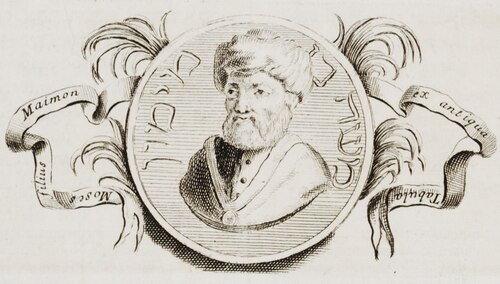
Sources and credit for Maimonides
Blaisio Ugolino. Via Wikimedia Commons. Image source · Public domain · Biographical dates
That attribution should be marked rather than treated as certain. His wider engagement with demonstration and philosophical reasoning is documented independently.
Hebrew translators and scholars, including members of the Ibn Tibbon family, helped circulate Arabic philosophical works. In Provence, Levi ben Gerson, or Gersonides (1288–1344), developed a substantial logical project in Hebrew. His Book of the Correct Syllogism, first composed in 1319, treats assertoric and modal syllogisms; his commentaries engage critically with Averroes. The historical account of Gersonides situates these writings alongside his mathematics and astronomy.
Jewish thinkers participated in and transformed these intellectual networks. Their role should not be reduced to serving as a bridge between two supposedly self-contained civilizations.
Why a fourth figure was worth defending
Gersonides defended recognizing a fourth syllogistic figure against Averroes's objections. The issue was not whether some valid conclusion could be obtained by rearranging the premises, but whether the system represented the particular conclusion being sought. An unfamiliar arrangement was not thereby invalid. Charles Manekin's edition and study of Gersonides's logic documents this argument and the different treatments of the figures.
Here is a modern class interpretation of a fourth-figure pattern, with and named by their positions in the intended conclusion:
- Every is .
- No is .
- Therefore, no is .
The middle term is the predicate of the first premise and the subject of the second. To verify the conclusion, suppose something were both and . The first premise would make it , contradicting the second premise. The contradiction excludes any overlap between and ; no assumption that either class is inhabited is needed in this reconstruction.
The same premises also yield “No is ,” whose conversion gives the stated conclusion. That observation explains why classification and reducibility are separate questions. A pattern can be reducible to others and still deserve a place in a systematic account of how to establish a specified conclusion. The example illustrates the controversy; it is not a transcription of Gersonides's notation or a claim that he invented the fourth figure.
Modal cases add a further burden. A term can occur as necessary or possible in one premise without licensing the same qualification in the conclusion. Gersonides's sustained treatment of such combinations belongs to the research history of syllogistic, beyond the history of translating Aristotle.
Latin reception and its limits
Arabic philosophical works and commentaries influenced medieval Latin discussions through identifiable translations and teaching traditions.
The extent of the influence varied by author and topic. Latin access to Avicenna's logical corpus was partial, while Averroes's commentaries had their own substantial reception.
The survey of Arabic and Islamic influence on the Latin West documents these routes and their limits. Neither “no influence” nor “all later developments came from this source” is an adequate generalization.
The next companion examines the Latin traditions in their own right, including theories of reference, consequence, and semantic paradox.
Check your understanding: can a valid form supply its own evidence?
Suppose “Every is ” and “This object is ” entail “This object is .” Does the validity of this deduction establish the universal premise?
No. It establishes the conditional relationship between the premises and conclusion. Observation, causal knowledge, definition, testimony, or another argument would have to warrant the premises in the relevant account of knowledge. A historically adequate explanation of demonstration must therefore discuss both inferential form and the source and explanatory role of its starting points.
Sources and further reading
- Al-Fārābī, logical writings and Enumeration of the Sciences.
- Ibn Sīnā, logical sections of The Healing, especially the works on interpretation, syllogism, and demonstration.
- Ibn Rushd, commentaries on Aristotle's logical works.
- Najm al-Dīn al-Kātibī, al-Risāla al-Shamsiyya.
- Ibn Sīnā's Logic, Language and Logic in Arabic and Islamic Philosophy, and Influence on the Latin West, Stanford Encyclopedia of Philosophy.
- Deborah L. Black, Logic and Aristotle's Rhetoric and Poetics in Medieval Arabic Philosophy (1990); Tony Street, “Arabic Logic,” in Handbook of the History of Logic, volume I (2004).
- Ibn Taymiyya, Against the Greek Logicians, translated by Wael B. Hallaq (1993); Ibn Taymiyya, for the scope and reception of his criticisms.
- Charles H. Manekin, The Logic of Gersonides (1991), including an edition, translation, and commentary on the Book of the Correct Syllogism; Gersonides, Stanford Encyclopedia of Philosophy, for historical context.