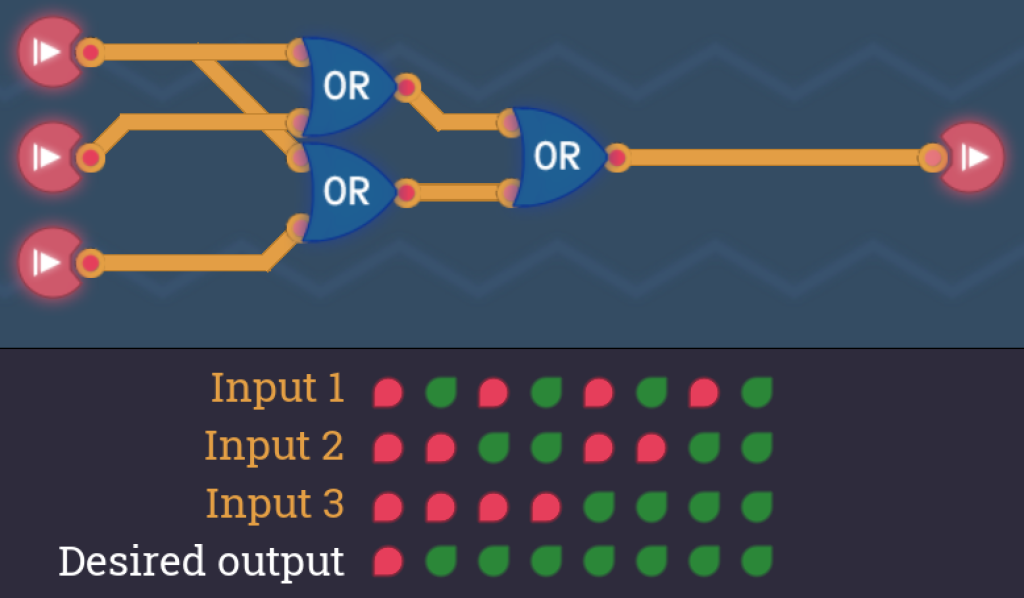
When I played Turing Complete in October 2021, I wondered whether there was a systematic way to construct a circuit from a truth table. Later, while reading Mendelson's Introduction to Mathematical Logic, functional completeness supplied the answer. Every Boolean function can be represented using AND, OR, and NOT; NOR alone is also sufficient.
This is an existence result. The circuit produced by the general construction can be much larger than necessary, so simplification is a separate problem.
From a truth table to a formula
Let and . The symbols are propositional variables; an assignment gives each symbol a truth value. Formulas are built from these symbols by negation and the binary connectives and , with parentheses specifying their structure.
For a row , define the literal
and its minterm . This formula is true exactly on the assignment .
Now take the disjunction of all minterms whose rows have output one:
On any input, precisely its own minterm is true. Therefore has the same truth value as on every input. This is disjunctive normal form (DNF).
There can be anywhere from to true rows. For the constant-false function, use ; for the constant-true function, use . The assumption ensures is available. Zero-input functions would require a separate convention for constants.
Example: simplify before building
Consider a function true on and and false on the other six assignments. The construction gives
Factoring out the shared conjunction,
The output does not depend on . A single two-input NOR gate implements the whole function.
A Python construction
The function below accepts a complete truth table. Each row contains input bits followed by one output bit. It rejects missing, duplicate, or malformed rows rather than silently treating an incomplete table as a complete function.
from itertools import product


def convert_to_dnf(truth_table):
    rows = [tuple(row) for row in truth_table]
    if not rows or len(rows[0]) < 2:
        raise ValueError("Provide a complete table with at least one input.")
    n = len(rows[0]) - 1
    if any(len(row) != n + 1 for row in rows):
        raise ValueError("Every row must have the same length.")
    if any(type(bit) not in (int, bool) or bit not in (0, 1)
           for row in rows for bit in row):
        raise ValueError("Inputs and outputs must be bits.")
    inputs = [row[:-1] for row in rows]
    if len(rows) != 2**n or len(set(inputs)) != 2**n:
        raise ValueError("Each input assignment must occur exactly once.")

    terms = []
    for row in rows:
        if row[-1] == 1:
            literals = [f"x_{j + 1}" if bit else f"¬x_{j + 1}"
                        for j, bit in enumerate(row[:-1])]
            terms.append("(" + " ∧ ".join(literals) + ")")
    if not terms:
        return "(x_1 ∧ ¬x_1)"
    if len(terms) == 2**n:
        return "(x_1 ∨ ¬x_1)"
    return " ∨ ".join(terms)


truth_table = [
    (*bits, int(bits[0] == 0 and bits[1] == 0))
    for bits in product((0, 1), repeat=3)
]
print(convert_to_dnf(truth_table))
The output is a formula, not a minimized circuit or a physical wiring plan. The construction can contain exponentially many terms because a truth table already has rows.
Why NOR alone is enough
Define . Then
Each identity can be checked on the four possible pairs of truth values. Replacing every NOT, OR, and AND in a DNF formula with its NOR construction yields a NOR-only formula for the same function. That proves functional completeness.
The result concerns finite combinational Boolean circuits. Memory, timing, and sequential behavior require additional structure; functional completeness alone does not build an entire computer.
The game that prompted the question
I recommended the game on Zhihu on October 23, 2021. Some of its construction puzzles were difficult for me then, and I put the algorithm question aside while preparing for exams. Learning the logic later gave me a reason to return to it.